Meet Yago, your business partner on WhatsApp
Meet Yago, your business partner on WhatsApp
Oct 15, 2025
💰 How to Measure the ROI of Your Virtual Seller on WhatsApp
Calculate the return on investment of your conversational assistant: metrics, simple formulas, and real signs of profitability.
Silvana Cabrera
Installing an AI assistant on WhatsApp may seem like an investment that is difficult to measure. You know it saves time, responds faster, and improves service, but how can you verify if it is really generating economic returns? In this practical guide, I will teach you how to calculate the ROI of your AI assistant: from implementation costs to impact on sales, average ticket value, and customer retention.
We will use simple formulas, real metrics, and applicable examples for any business, whether you handle 100 or 10,000 conversations per month.
📊 What is ROI and why should you measure it?
ROI (Return on Investment) indicates how profitable an investment was in relation to what it cost. In the case of an AI assistant on WhatsApp, it's not just about how much you sell, but how much you save and optimize in your operation.
Measuring it allows you to:
Know if the system is really worth the cost.
Compare performance with other channels or campaigns.
Justify the investment to your team or management.
Make data-driven decisions, not based on perceptions.
📐 Basic formula:

If you invest S/2,000 in automation and generate S/6,000 in additional sales or resource savings, your ROI would be 200%.
👉 Before calculating, I recommend reading our guide on how to analyze social media statistics, where I explain how to turn data into real decisions.
⚙️ Step 1: Define your investment costs
Your ROI depends on understanding how much you are really investing. Include all direct and indirect costs:
💬 AI platform or provider: monthly or annual cost of the assistant.
🧩 Technical integrations: if you connect your CRM, payment gateways, or marketing tools.
⏱ ️ Configuration hours: time from your team or a specialist to train the bot.
💻 Maintenance: adjustments, new workflows, or technical support.
💡 Example:
Your assistant costs S/400 per month, plus S/600 for initial configuration. In three months, your total investment would be S/1,800.
💬 Step 2: Measure savings in man-hours
The AI assistant does not only generate sales: it frees up time. Calculate how many weekly hours you save thanks to automatic responses, client classification, or lead generation.
Practical example:
Before: an advisor handled 200 messages per day (4 minutes each).
Now: the AI resolves 70% of the messages without human intervention.
Savings: 9.3 hours daily ≈ 186 hours per month.
If your team's average hourly cost is S/10, your monthly savings would be S/1,860 just in operational time.
👉 In our article on AI agents vs traditional customer service, we analyze how this type of savings directly translates into efficiency.
And if you use an assistant like Yavendió!, you can easily measure this impact with automatic reports of attended conversations, instant responses, and tickets closed without human intervention.
📈 Step 3: Calculate the impact on sales
Your assistant can generate additional income by:
Offering complementary products (cross-selling).
Suggesting premium versions (upselling).
Recovering abandoned carts or unanswered messages.
Sending automated purchase or renewal reminders.
To measure it, compare sales before and after implementation.
Simple example:
Before the assistant: S/10,000 monthly.
After the assistant: S/13,000 monthly.
The increase of S/3,000 equates to 30% more sales attributable to AI.
👉 If you're not yet using AI to increase the average ticket, see how to do it with our guide on automatic upselling and cross-selling on WhatsApp.
📊 Step 4: Measure retention and conversion metrics
ROI not only depends on how much you sell but also on how many customers return and how quickly you respond.
These are the key metrics to evaluate your assistant's performance:
Metric | What it measures | Healthy indicator |
🕒 Average response time | Efficiency of service | < 10 seconds |
💬 Automatically resolved conversations | Level of automation | > 70% |
💸 Conversion rate | Chats ending in sale | 10% – 25% |
🔁 Retention | Customers returning to write | > 40% |
If these numbers improve, your assistant is generating return, even if you do not see it immediately in sales.
📐 Step 5: Calculate your real ROI
Now combine the previous data into the initial formula:

💡 Example:
Profit (sales + savings): S/5,000,
Total investment: S/1,800
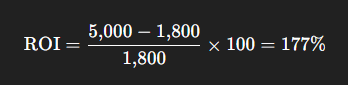
Your assistant is generating S/1.77 for every sol invested.

🧠 How to interpret your results
A positive ROI not only means "to earn more," but also to optimize resources. If your assistant reduces service time and increases customer satisfaction, you are already seeing profitability, even though revenues may not grow at the same pace.
Analyze the return from three angles:
Efficiency: automated tasks and less operational load.
Conversion: more closed sales, higher average tickets.
Loyalty: customers returning because they feel well attended.
AI not only sells; it creates experiences that foster loyalty.
💬 Conclusion: ROI is also measured in trust
Measuring the ROI of your AI assistant on WhatsApp allows you to validate with data something that many businesses already sense: automation is not an expense, it is an investment that returns time, sales, and satisfaction.
You don't need complex formulas or consultants. Just clarity, records, and consistency. Review your numbers each month, adjust your flows, and let AI work with you, not in your place.
Because the true return is not only in the figures, but in the peace of mind knowing that your business continues to sell even when you are not connected. 💬💸
Installing an AI assistant on WhatsApp may seem like an investment that is difficult to measure. You know it saves time, responds faster, and improves service, but how can you verify if it is really generating economic returns? In this practical guide, I will teach you how to calculate the ROI of your AI assistant: from implementation costs to impact on sales, average ticket value, and customer retention.
We will use simple formulas, real metrics, and applicable examples for any business, whether you handle 100 or 10,000 conversations per month.
📊 What is ROI and why should you measure it?
ROI (Return on Investment) indicates how profitable an investment was in relation to what it cost. In the case of an AI assistant on WhatsApp, it's not just about how much you sell, but how much you save and optimize in your operation.
Measuring it allows you to:
Know if the system is really worth the cost.
Compare performance with other channels or campaigns.
Justify the investment to your team or management.
Make data-driven decisions, not based on perceptions.
📐 Basic formula:
If you invest S/2,000 in automation and generate S/6,000 in additional sales or resource savings, your ROI would be 200%.
👉 Before calculating, I recommend reading our guide on how to analyze social media statistics, where I explain how to turn data into real decisions.
⚙️ Step 1: Define your investment costs
Your ROI depends on understanding how much you are really investing. Include all direct and indirect costs:
💬 AI platform or provider: monthly or annual cost of the assistant.
🧩 Technical integrations: if you connect your CRM, payment gateways, or marketing tools.
⏱ ️ Configuration hours: time from your team or a specialist to train the bot.
💻 Maintenance: adjustments, new workflows, or technical support.
💡 Example:
Your assistant costs S/400 per month, plus S/600 for initial configuration. In three months, your total investment would be S/1,800.
💬 Step 2: Measure savings in man-hours
The AI assistant does not only generate sales: it frees up time. Calculate how many weekly hours you save thanks to automatic responses, client classification, or lead generation.
Practical example:
Before: an advisor handled 200 messages per day (4 minutes each).
Now: the AI resolves 70% of the messages without human intervention.
Savings: 9.3 hours daily ≈ 186 hours per month.
If your team's average hourly cost is S/10, your monthly savings would be S/1,860 just in operational time.
👉 In our article on AI agents vs traditional customer service, we analyze how this type of savings directly translates into efficiency.
And if you use an assistant like Yavendió!, you can easily measure this impact with automatic reports of attended conversations, instant responses, and tickets closed without human intervention.
📈 Step 3: Calculate the impact on sales
Your assistant can generate additional income by:
Offering complementary products (cross-selling).
Suggesting premium versions (upselling).
Recovering abandoned carts or unanswered messages.
Sending automated purchase or renewal reminders.
To measure it, compare sales before and after implementation.
Simple example:
Before the assistant: S/10,000 monthly.
After the assistant: S/13,000 monthly.
The increase of S/3,000 equates to 30% more sales attributable to AI.
👉 If you're not yet using AI to increase the average ticket, see how to do it with our guide on automatic upselling and cross-selling on WhatsApp.
📊 Step 4: Measure retention and conversion metrics
ROI not only depends on how much you sell but also on how many customers return and how quickly you respond.
These are the key metrics to evaluate your assistant's performance:
Metric | What it measures | Healthy indicator |
🕒 Average response time | Efficiency of service | < 10 seconds |
💬 Automatically resolved conversations | Level of automation | > 70% |
💸 Conversion rate | Chats ending in sale | 10% – 25% |
🔁 Retention | Customers returning to write | > 40% |
If these numbers improve, your assistant is generating return, even if you do not see it immediately in sales.
📐 Step 5: Calculate your real ROI
Now combine the previous data into the initial formula:
💡 Example:
Profit (sales + savings): S/5,000,
Total investment: S/1,800
Your assistant is generating S/1.77 for every sol invested.
🧠 How to interpret your results
A positive ROI not only means "to earn more," but also to optimize resources. If your assistant reduces service time and increases customer satisfaction, you are already seeing profitability, even though revenues may not grow at the same pace.
Analyze the return from three angles:
Efficiency: automated tasks and less operational load.
Conversion: more closed sales, higher average tickets.
Loyalty: customers returning because they feel well attended.
AI not only sells; it creates experiences that foster loyalty.
💬 Conclusion: ROI is also measured in trust
Measuring the ROI of your AI assistant on WhatsApp allows you to validate with data something that many businesses already sense: automation is not an expense, it is an investment that returns time, sales, and satisfaction.
You don't need complex formulas or consultants. Just clarity, records, and consistency. Review your numbers each month, adjust your flows, and let AI work with you, not in your place.
Because the true return is not only in the figures, but in the peace of mind knowing that your business continues to sell even when you are not connected. 💬💸
Oct 15, 2025
Bring the magic to your sales TODAY!
Get a demo


Bring the magic to your sales TODAY!
Get a demo
@2024 YA VENDIO - All rights reserved
@2024 YA VENDIO - All rights reserved